
By Felix Schöfbänker
This is a review that shows the performance of the QHY5III678M planetary camera for ground-based imaging of satellites. I will showcase the specifications of the camera and example images I have taken with it of several satellites.
As a short introduction to myself, my equipment, and my hobby, my name is Felix Schöfbänker, and I am an amateur satellite photographer from Austria. Currently, I use a 14” GoTo Dobsonian from Skywatcher as my main telescope. My interest in astrophotography started at the beginning of 2022, when I got an 8” Newtonian on an equatorial mount for deep-sky astrophotography. Then, around late 2023, my interest switched over to satellite imaging and tracking, which are the main kinds of activities I perform now.
All my images can be found on my AstroBin account: https://app.astrobin.com/u/fel_sch
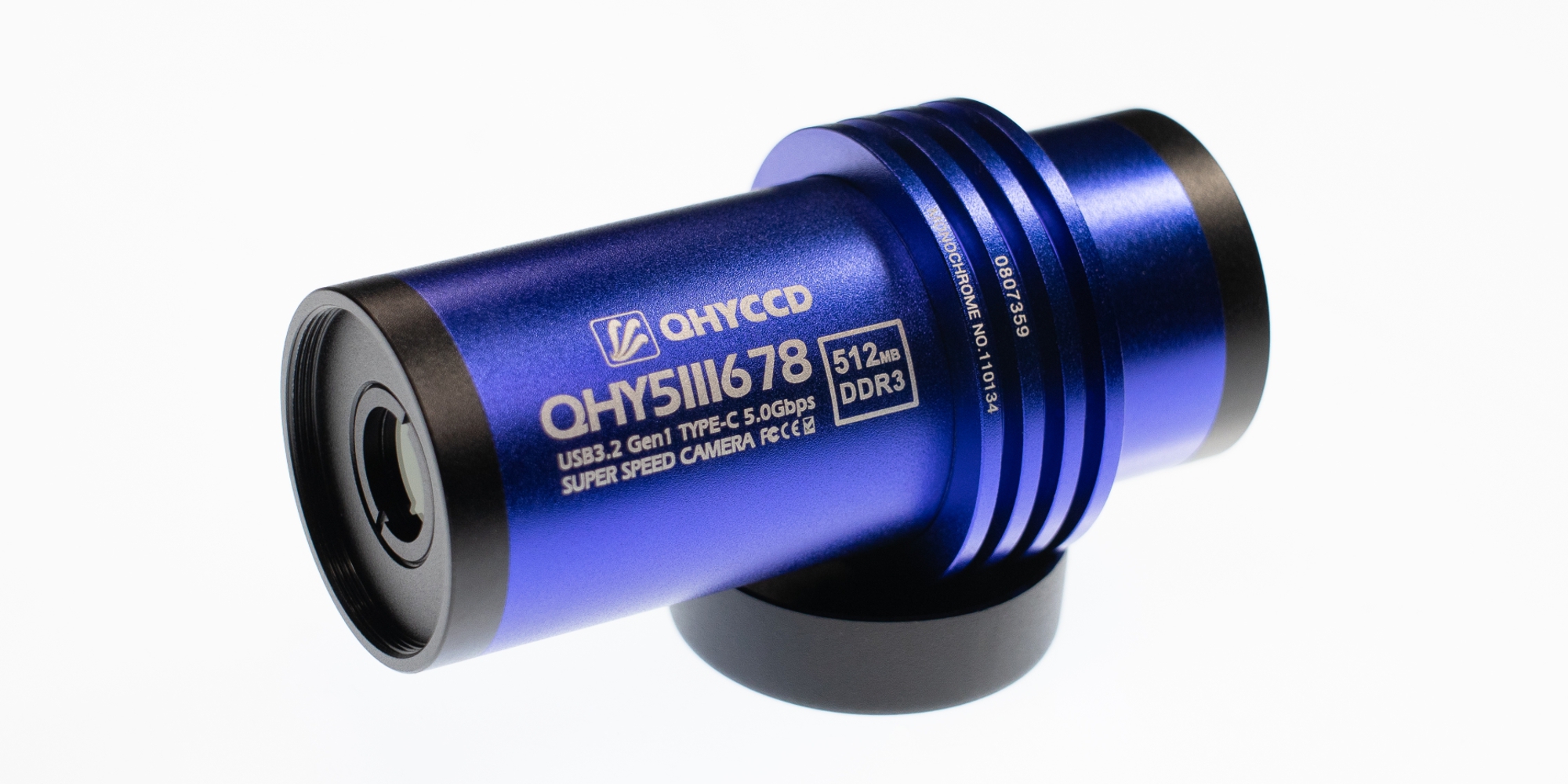
Contents of the Box
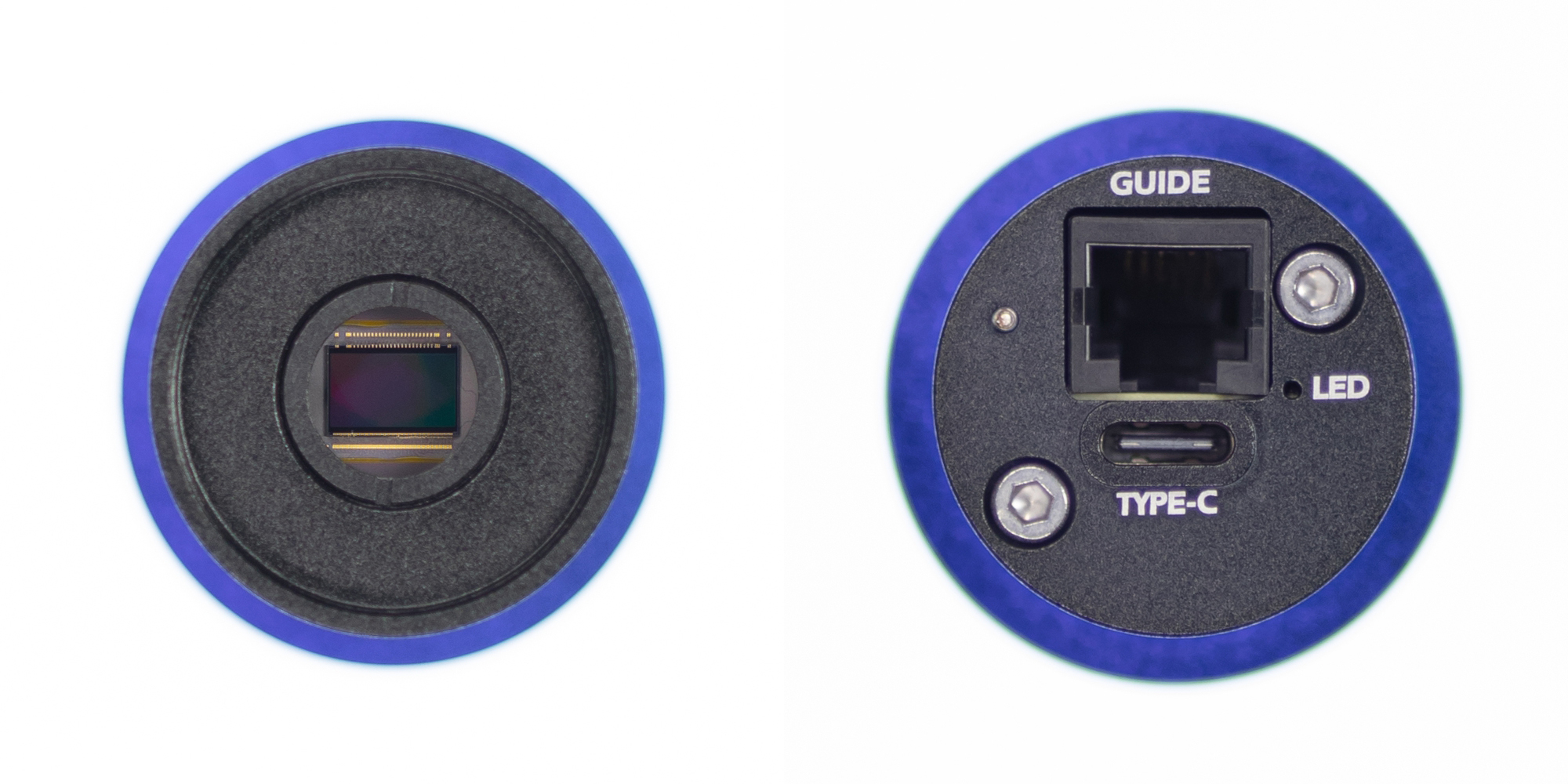
– QHY5III678M planetary camera
– Focus lock ring with plastic-tipped thumbscrew
– 1.8m long USB 3.0 TYPE-C cable
– 1.5m long ST4 guiding cable
– IR850 Filter, unmounted, for use at the camera’s front window (12.5 x 0.7mm)
– 1.25” to CS-Mount adapter + CS to C-Mount lens adapter
– spare front window screw
– paper containing Driver download instructions and a “What’s in the Box?” Card
Camera description
The QHY5III678M planetary camera uses Sony’s monochrome IMX678 CMOS sensor, which can be seen as an upgraded version of Sony’s IMX178 sensor. The main upgrades and changes are:
- improved sensitivity, especially in the infrared part of the spectrum
- smaller pixel size on an almost identical sensor size
Technical specifications of the camera are as follows:
- 3856 x 2180-pixel maximal capture area (8.4 MP)
- 7.71 X 4.36 mm physical sensor size (8.86 mm diagonal)
- 2.0-micron pixels size
- 12-bit depth
- 512MB DDR3 buffer storage
Pixel pitch
The resolution I achieve with this camera is 0.135” / pixel (14” F4.8 + 2x Barlow), which is considerably more useful than the 0.164” / pixel the IMX 178 sensor gives with the same Barlow lens due to its larger pixels.
Using the 5-7x Rule, which states that the optimal F-ratio for a camera is 5-7 times its pixel size in microns, the cameras are optimal for the following focal ratios:
IMX678 with 2-micron pixels: F10 to 14
IMX178 with 2.4-micron pixels: F12 to F16.8
FPS performance
From my testing, the camera performs at the following FPS speeds for each resolution:
- 3856 x 2180 Pixels 16/8 bit = 22/43 FPS
- 1500 x 1500 Pixels 16/8 bit = 31/61 FPS
- 1000 x 1000 Pixels 16/8 bit = 47/92 FPS
- 500 x 500 Pixels 16/8 bit = 90/175 FPS
- 100 x 100 Pixels 16/8 bit = 345/675 FPS
For satellite imaging, high FPS count is one of the most important features for any camera that’s intended to be used for this type of imaging, due to the short timeframes where you can capture the satellite from the same angle, which is often no more than a few seconds. For this reason, I also recommend using 8-bit mode for most targets.
All measurements were made with FireCapture; 15-second-long videos were recorded to the laptop’s internal SSD.
Laptop: ThinkPad P51
Sensitivity
Another factor that makes this camera better suited than the IMX178 for this type of imaging is the noticeably improved IR sensitivity.
See the absolute quantum efficiency of the IMX 178 compared to the relative quantum efficiency of the IMX 678:

High infrared sensitivity is one of the most important factors when deciding on a monochrome camera for satellite imaging since you will only really use these types of filters. I have IR610, IR685, IR742, and IR807, although I mostly use the first two.
To get an idea of the IR sensitivity relative to the IMX178 sensor, I took images of Saturn with all four filters:
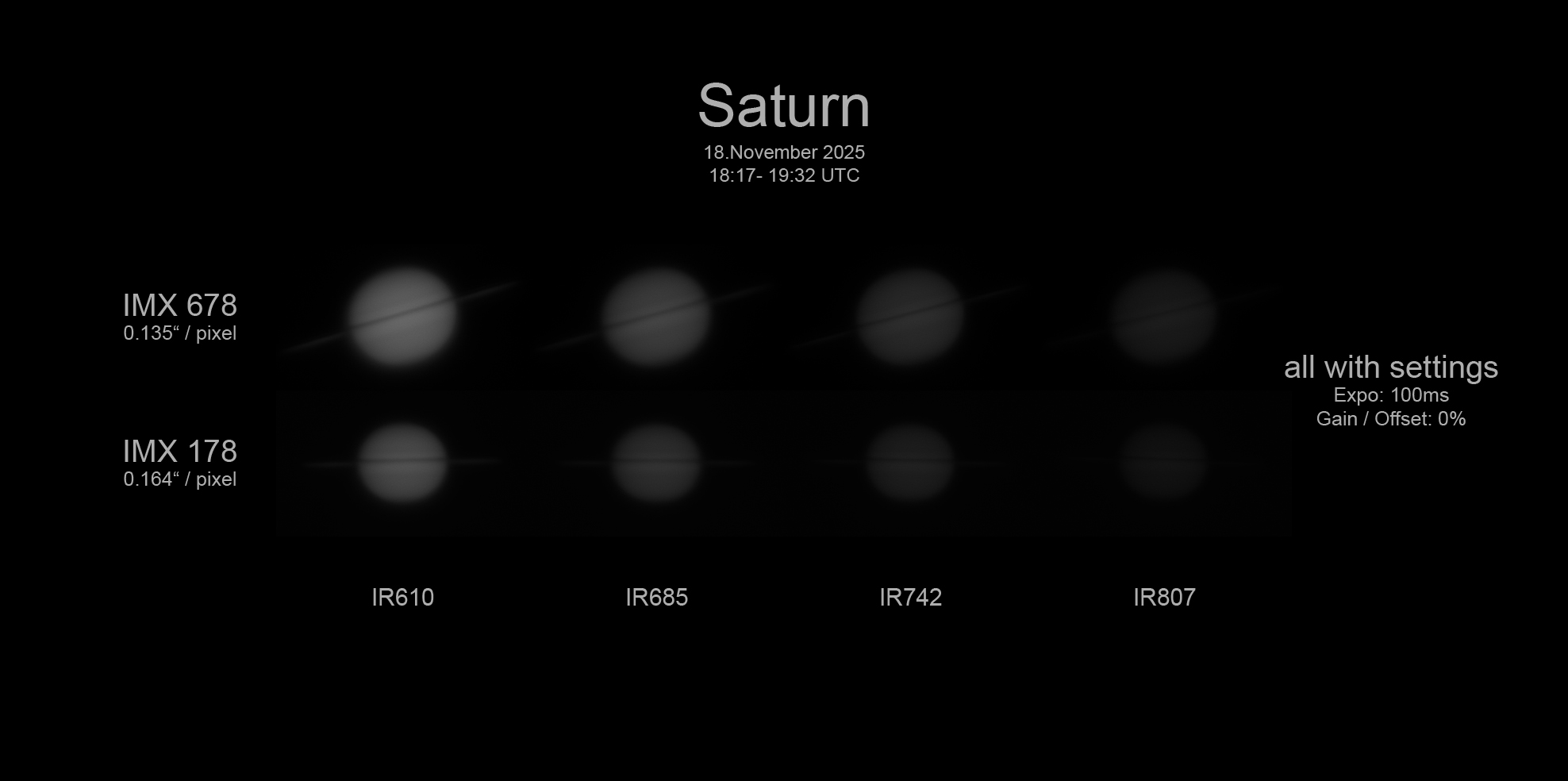
All images were taken under the same conditions, using a Lacerta 2x telecentric Barlow lens and the same exposure of 100 ms and gain/offset of 0.
One thing to note is that due to the IMX 178 having bigger pixels, it is more sensitive to light than the IMX 678, though even considering that the IMX 678 has pixels 18% smaller in size/36% in area than the IMX 178, the IMX 678 produces a very similar level of brightness to the 178 due to the much-improved IR sensitivity.
Satellite images I have taken
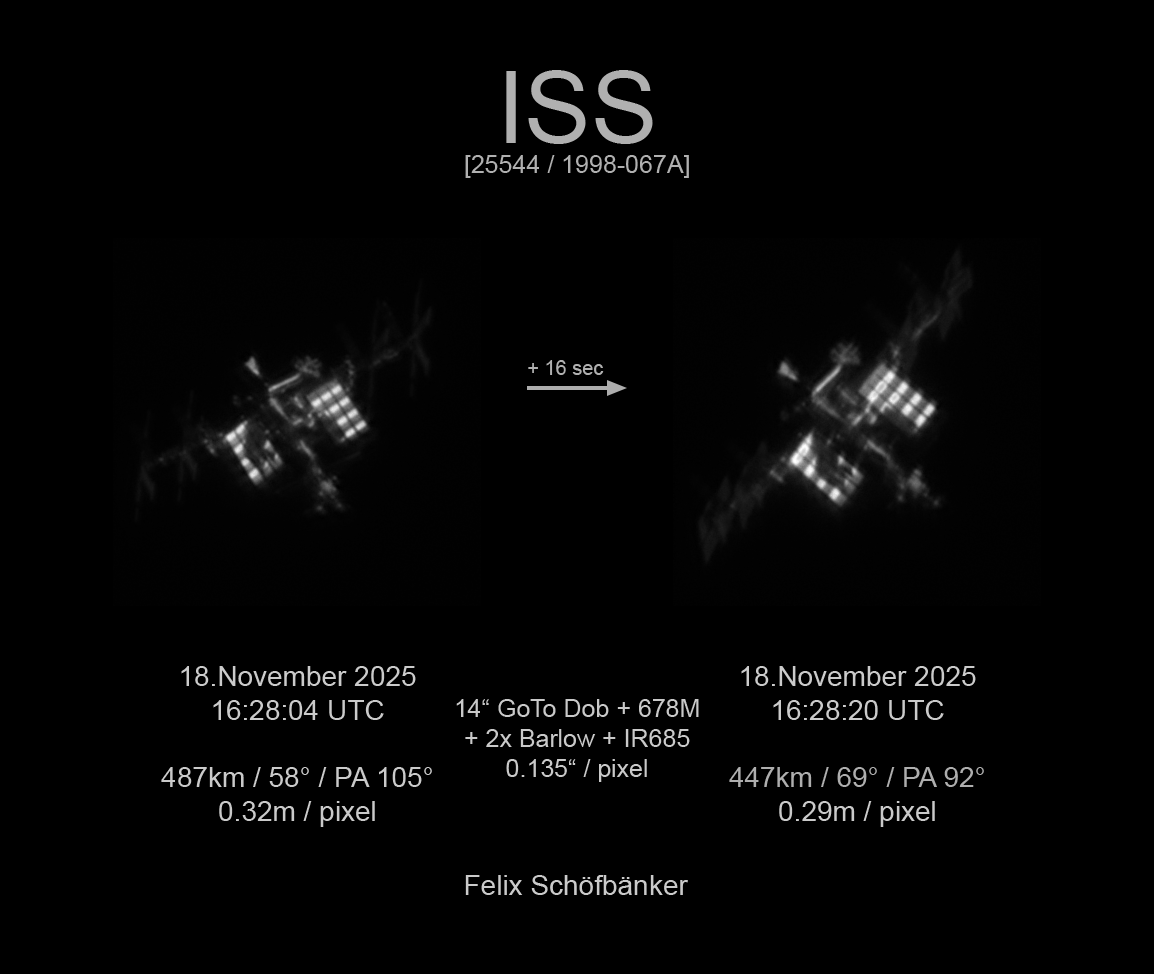
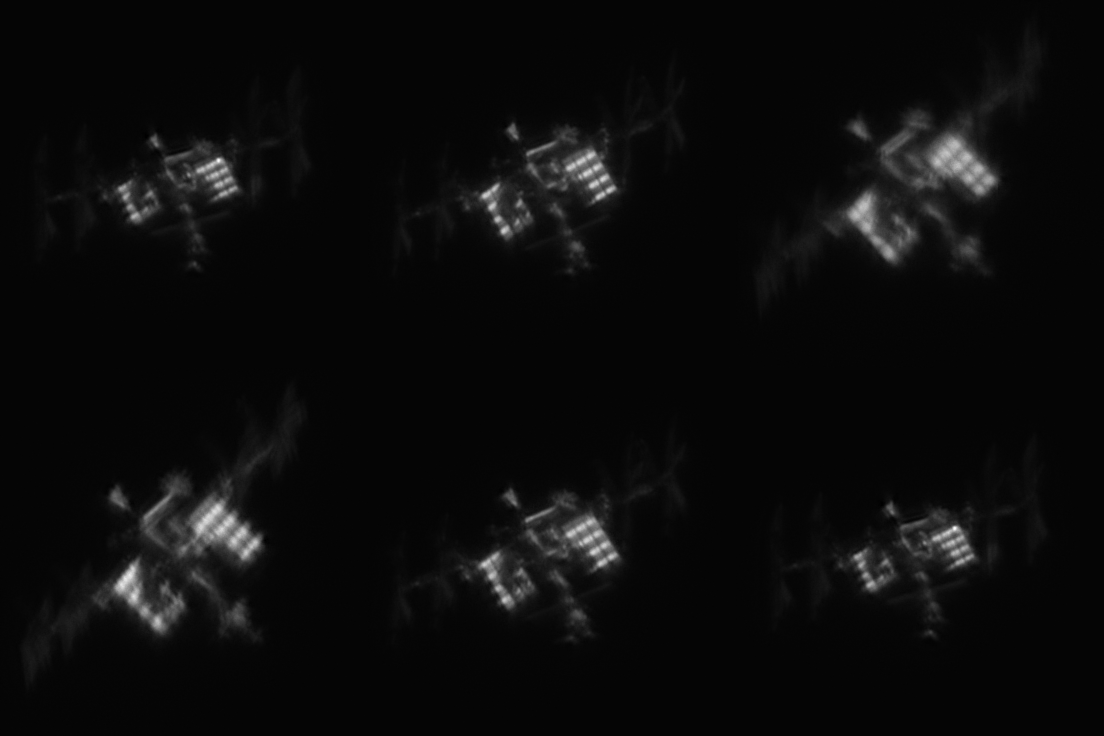 The International Space Station, probably one of the most famous satellites,
has a wingspan of 109 m and orbits around 415 km above the earth’s surface. Recorded at 61 FPS.
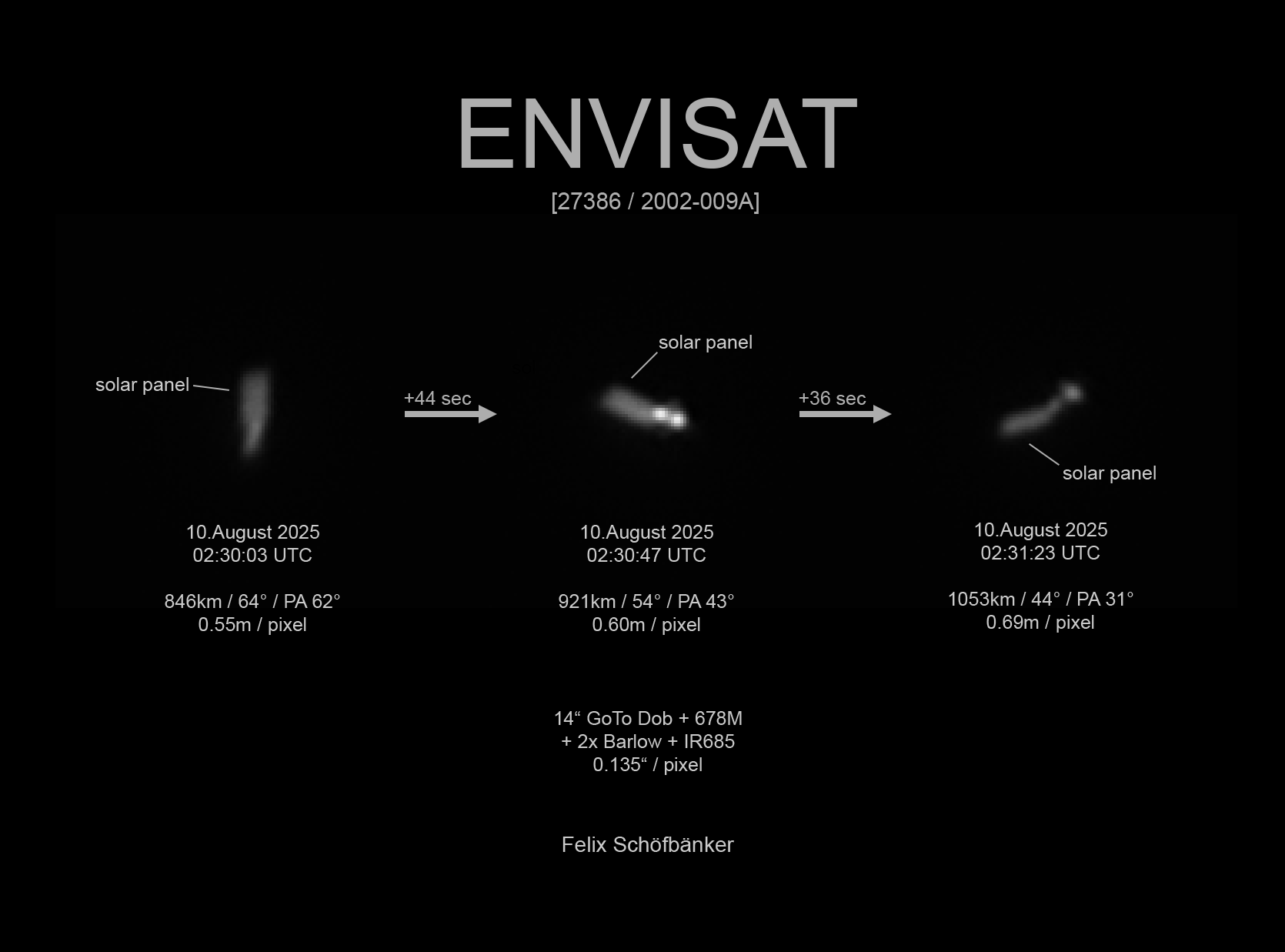
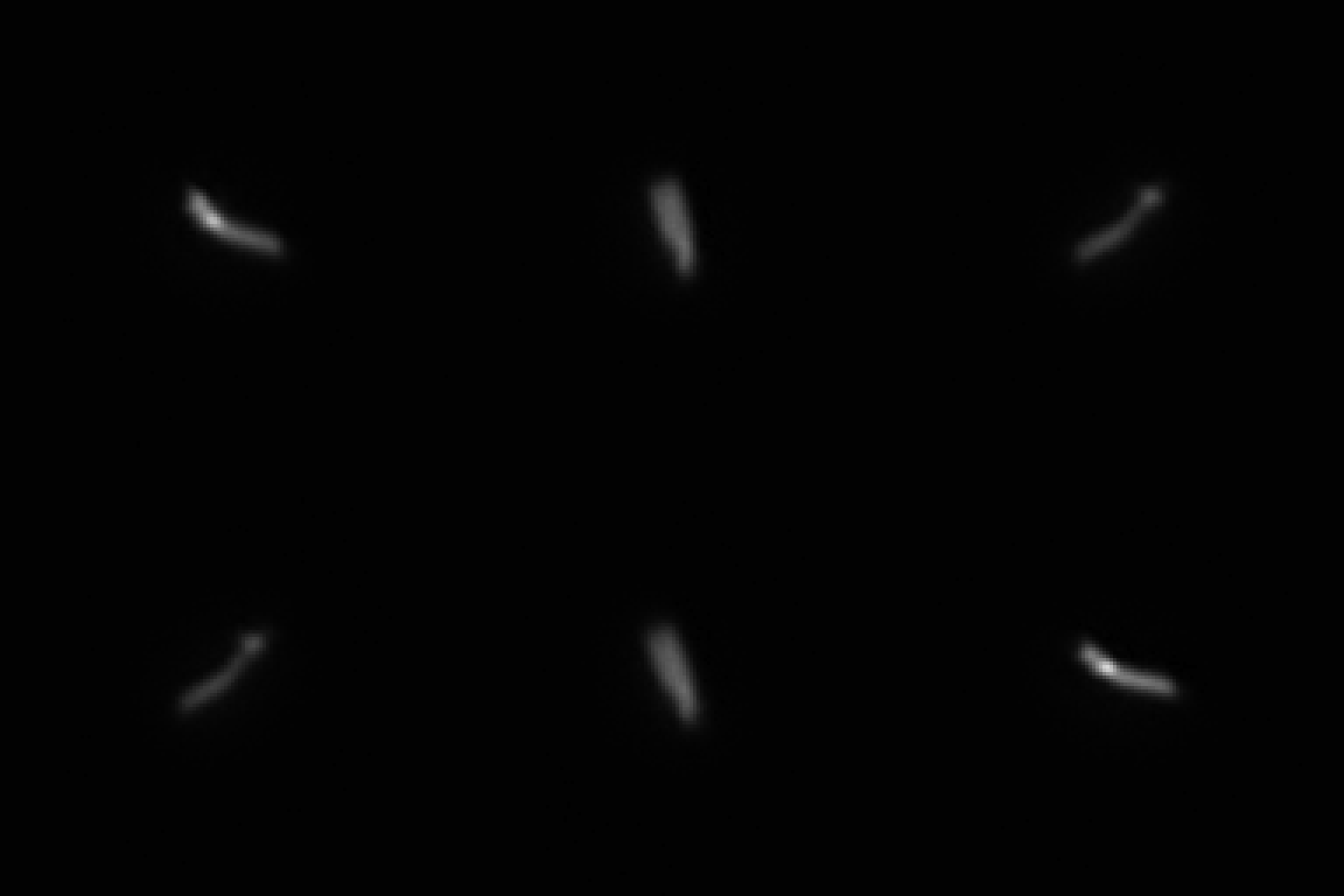 The Earth observation satellite from the European Space Agency launched in 2002; it was operational up until April of 2012. In the animation, it can be seen slowly tumbling. It is 26 m long and has an orbital altitude of around 760 km. Recorded at 75 FPS.
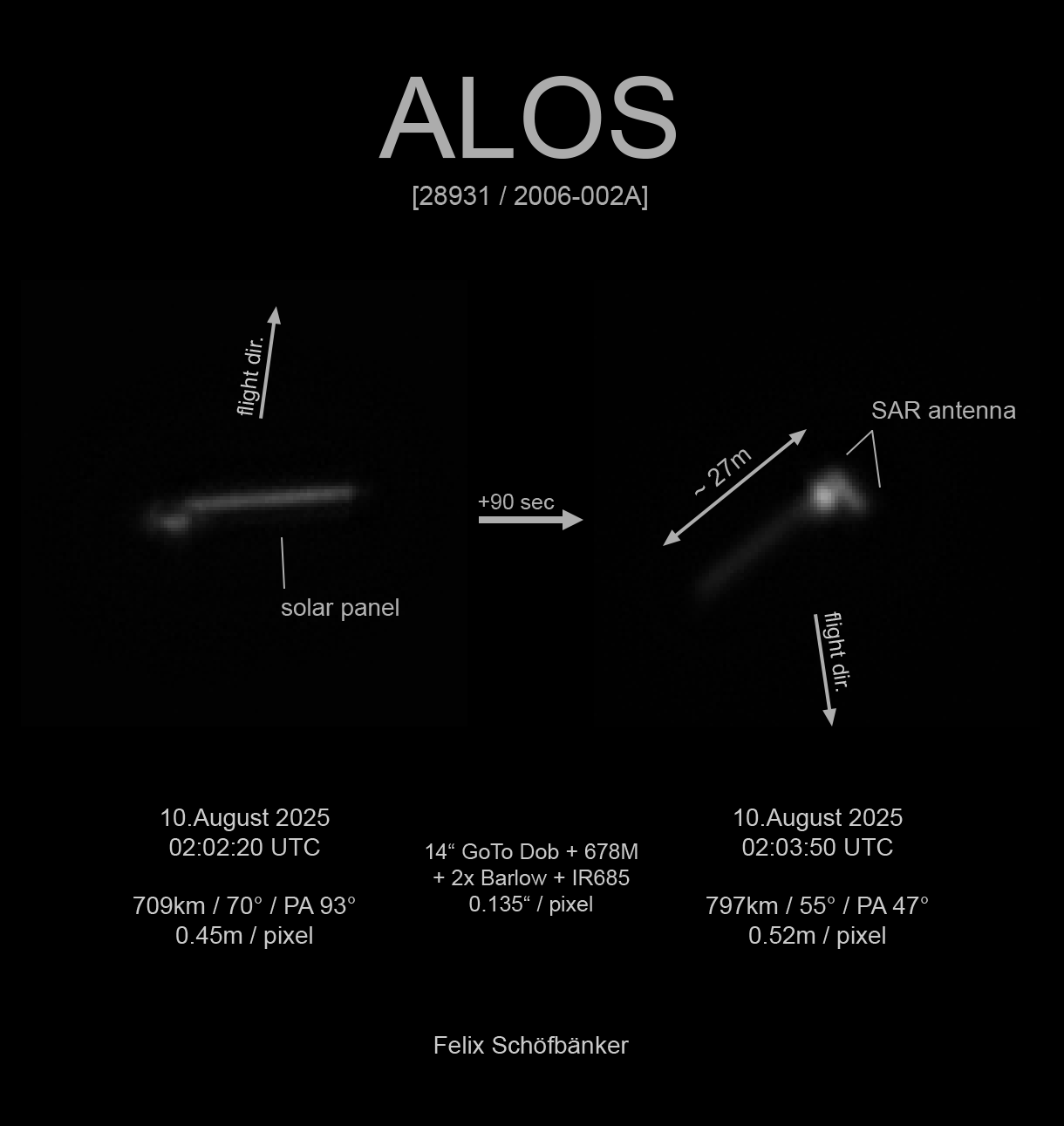 The “Advanced Land Observing Satellite” is a defunct earth observation satellite from the Japanese Space Agency.
It has a total length of 27.4 meters, and it orbits around 670 km above the earth’s surface. Recorded at 83 FPS.
Summary
After testing the QHY5III678M camera, I can say that it noticeably outperforms the IMX 178 sensor, mainly due to the improved sensitivity, which allows me to get a relatively good SNR even though the pixels are around 36% smaller in terms of surface area, which, as mentioned, allowed for a better plate scale in my case. It also performs acceptably in FPS speeds, reaching similar levels to the IMX 178.